The Thesis: M&A as a Macro Confidence Indicator
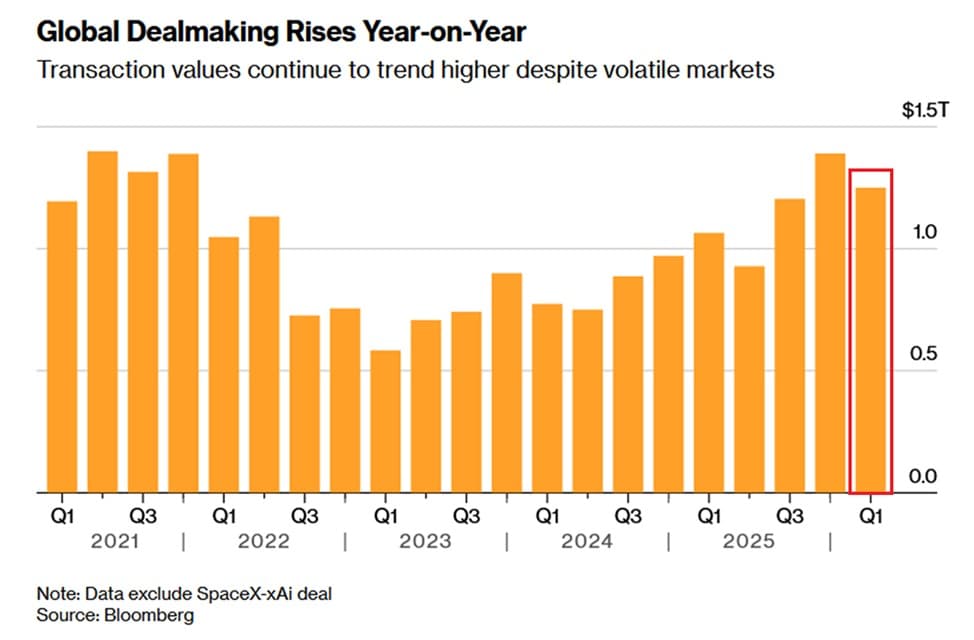
The Kobeissi Letter flagged the headline number on April 10th: global M&A transaction values hit $1.25 trillion in Q1 2026, up 18% year-over-year, the largest Q1 total on record. The specific deals named — Unilever's $44.8 billion food business sale to McCormick and Sysco's $29.1 billion transaction — aren't just big numbers. They're signatures on multi-year bets about the future of credit, earnings, and the macro environment.
That's the thesis. Here's what it means, and what the Kobeissi thread didn't have room to say.
Why M&A Is a Better Confidence Signal Than Surveys
Sentiment surveys are cheap. CEO confidence indices, consumer sentiment readings, PMI soft data — these cost nothing to produce and reflect what people say they believe. M&A is different. When a board approves a $44.8 billion acquisition, they're not filling out a survey. They're committing capital, taking on debt, and betting their tenure on the outcome.
Think of it this way: a survey is someone telling you they think the restaurant is good. M&A is someone buying the restaurant. The second signal carries more weight.
This is why the record Q1 number deserves more than a headline. It's a real-money vote against the recession narrative that has been circulating in macro circles since 2023. Three consecutive years of "recession incoming" calls, and the corporate sector is responding by signing the largest Q1 dealmaking total ever recorded. That's not confidence — that's conviction.
The Macro Backdrop That Makes This Possible
Record M&A doesn't happen in a vacuum. It requires three things: accessible credit, reasonable equity valuations as deal currency, and a forward earnings outlook that makes the math work. Right now, all three are present — and that's the part of the story that deserves more scrutiny.
Credit conditions: Investment-grade credit spreads remain historically tight. The ICE BofA IG Corporate Index option-adjusted spread has been trading in the 80-100 basis point range — well below the 150-200bps levels that historically signal stress. Tight spreads mean cheap debt financing for acquirers. Cheap debt financing means deals that wouldn't pencil at 2022 rates can now close. The Fed's rate path matters here: with the effective Fed funds rate still in restrictive territory above 4%, the fact that IG spreads are this tight signals that credit markets are not pricing in a hard landing. They're pricing in a soft one — or no landing at all.
Equity valuations: The S&P 500's forward P/E has been running in the 20-22x range. That's not cheap, but it creates useful deal currency. When your stock trades at a premium, acquisitions financed with equity become more accretive. The Unilever-McCormick structure is worth watching for exactly this reason — the terms will reveal how much of the $44.8 billion is debt versus equity, and that ratio tells you something about how both boards view their respective balance sheets.
Earnings resilience: S&P 500 operating earnings have held up better than the macro bears predicted. Q4 2025 earnings growth came in around 12-14% year-over-year, and Q1 2026 consensus estimates are tracking positive. You don't sign a $29 billion deal if you think earnings are about to fall off a cliff. The Sysco transaction in particular — a food distribution play — implies confidence in consumer spending durability and restaurant sector health. That's a specific macro bet embedded in a single deal.
The Deals Themselves: What They're Betting On
The two anchor deals named in the Kobeissi post aren't random. They're thematically coherent.
Unilever → McCormick ($44.8B): Unilever has been restructuring aggressively, shedding non-core assets to focus on higher-margin personal care and home care. Selling the food business is a strategic retreat from a lower-margin category. McCormick, as the acquirer, is making the opposite bet: that branded food ingredients and flavoring have durable pricing power even in a consumer environment where private label has been gaining share. This is a bet on brand moats holding in an inflationary aftermath. The $44.8 billion price tag implies McCormick is paying a significant multiple for that durability.
Sysco ($29.1B): Sysco is the largest food distributor in North America. A $29 billion transaction at this scale is a bet on food service volume — restaurants, institutions, hospitality. The post-pandemic restaurant recovery has been uneven, but Sysco's willingness to commit at this size suggests their internal demand data is constructive. Food distribution is a volume business with thin margins; you only pay up for it when you believe volume is durable.
Both deals share a common thread: they're consumer-facing, inflation-adjacent, and implicitly betting that the consumer doesn't crack. That's the macro thesis embedded in the dealmaking data.
What the Bears Are Missing
The persistent recession narrative has been built on a specific sequence: Fed hikes → credit tight
This article was inspired by a post from @Kobeissiletter. AC's analysis adds original research, data context, and editorial perspective.