
Macro.
The big picture. Liquidity, rates, credit, global flows: the forces that move everything before CNBC figures out why. Most financial media covers symptoms. We cover the disease.
Hormuz, Closed Again: Monday Opens Into A Tape That Just Partied on the Wrong News
As of Friday 04-17 close, the tape was celebrating de-escalation — USO -7.79%, XLE -2.76%, S&P 7,022 near all-time highs, VIX at 17.94. On Saturday 04-18, Iran re-closed the Strait of Hormuz after the US refused to lift conditions, breaking the framework that Friday's rally was pricing. Sunday-night futures open is the first repricing event. Here's the timeline, the levels, and three scenarios for a week that starts in a cause-and-effect inversion.
The strait snapped shut again. Friday's COT already had the map.
The Boomer Cliff Is Overhyped. Here Is What Actually Breaks Passive.
The Dollar's Reserve Share Is Down. Its Grip on the Plumbing Isn't.
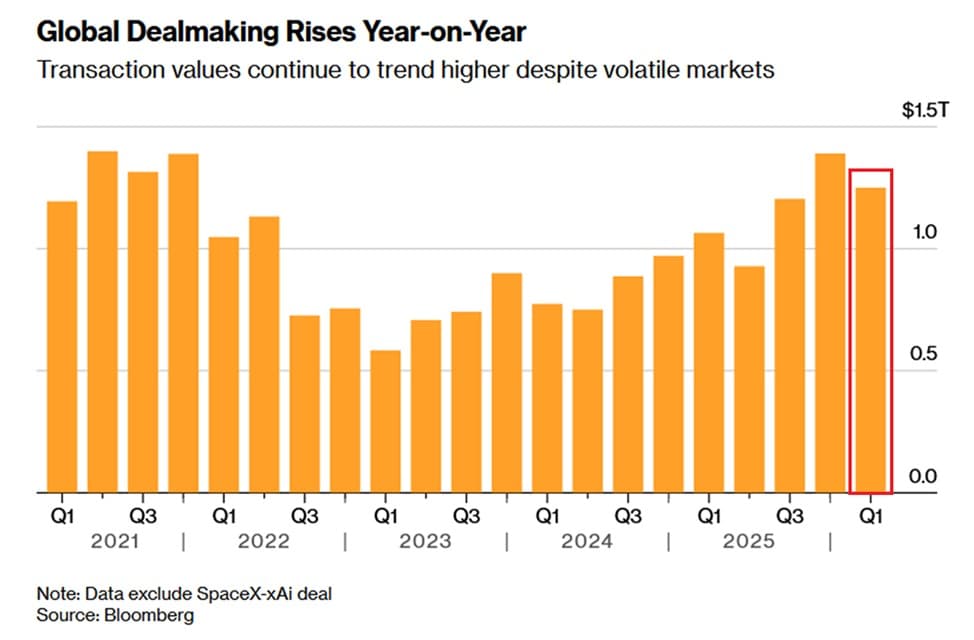
Global M&A Hits Record $1.25 Trillion in Q1. Capital Is Voting Against the Recession Narrative.

AI Crosses Into Agentic Era — Compute Demand Just Jumped a Thousandfold
The shift from chatbot to agentic AI isn't a product upgrade — it's a compute demand shock. When a system stops answering questions and starts executing tasks autonomously, the infrastructure required doesn't scale linearly — it multiplies. We're talking a thousandfold increase in compute demand, and the capital expenditure cycle underneath it is just getting started.
Dimon Hedges on Private Credit Risk: "Probably" Says It All
Jamie Dimon just handed markets a confession buried in thousands of words of corporate boilerplate — and it fits in one word: "probably." The head of the world's largest Western bank cannot say private credit is safe, only that it's *probably* not systemic, and that hedge should terrify anyone exposed to leveraged lending right now. When the most powerful banker on earth can't rule out a crisis, the question isn't if the credit cycle breaks — it's whether you'll see it coming.

Dollar-Yen at 160 — Hendry Sees 200 as the Deflationary Trigger
When the yen breaks 160, the real damage isn't in Tokyo — it's in the dollar-yuan rate, where a forced competitive devaluation would export deflation across every supply chain plugged into China. Hugh Hendry's 200 target isn't a number pulled from thin air: Japan already burns 30-35% of government revenue servicing debt at *zero* rates — the same fiscal load the U.S. carries at 5.5%. One rate hike and Japan doesn't slow down, it detonates.

Houthi Entry Threatens Red Sea Oil Routes, Prices Spike
The Houthis have entered the war — and the Red Sea is now in play. With Bab-el-Mandeb potentially at risk, Saudi Arabia's critical pipeline bypass route to Asian markets faces disruption, and the UAE's Fujairah port has already seen vessel loadings blocked. Oil is trading above $115, and traders are pricing escalation, not peace.
Oil Shock Meets Zero-Margin Economy — Layoffs Are the Only Math That Works
Corporate profit margins were already sitting at near-zero before the first barrel of Iranian oil got priced in. Now diesel costs are spiking, consumers are tapped out, and S&P Global's March PMI just flashed its first employment contraction in over a year — meaning businesses facing a margin squeeze have exactly one lever left to pull. Layoffs aren't a risk scenario here. They're the arithmetic.
Private Credit Gates Spread to Apollo's $15B Fund — $22T Shadow System Cracks
When a $15 billion fund can only honor 44 cents of every redemption dollar requested, that's not a liquidity management issue — that's a solvency signal dressed in paperwork. Private credit's entire pitch to retail investors rested on the myth of "semi-liquid" — and Apollo just torched it, with $22 trillion in shadow banking AUM now carrying marks that one of Apollo's own executives admitted could be worth 20 to 40 cents on the dollar.