The Dollar's Slow Demotion
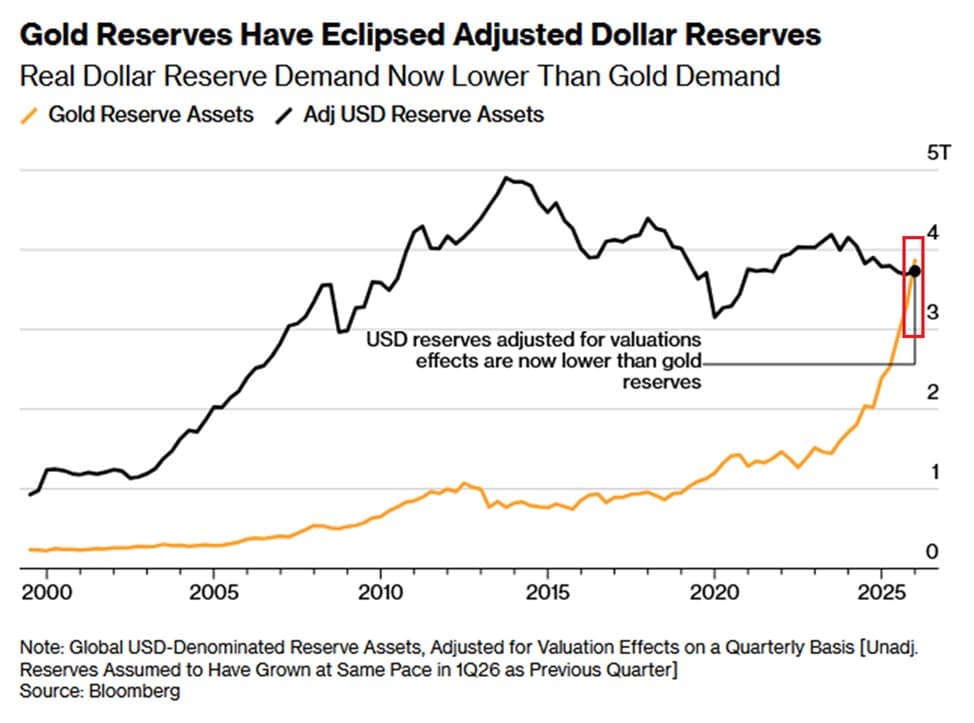
For the first time in recorded history, global central banks collectively hold more value in gold than in valuation-adjusted US dollar assets. Not a rounding error. Not a blip. A structural crossing that's been building for years and just became impossible to ignore.
The Kobeissi Letter flagged the chart on April 11, 2026, and the framing is correct: this is a reshaping, not a revolution. The dollar isn't dead. But its throne just got smaller.
What "Valuation-Adjusted" Actually Means
The distinction matters, so don't skip it. Valuation-adjusted dollar reserves strip out the interest earned on holdings like US Treasuries — they show only the principal, the actual dollars central banks chose to park in dollar-denominated assets. Think of it as the difference between what's in your checking account versus what's in your checking account plus all the interest you've collected over the years. The adjusted figure shows intent. And right now, central bank intent is pointing away from the dollar.
Gold holdings — priced at current market value, with GLD sitting at $437.13 as of this writing — have crossed above that adjusted dollar figure. The metal beats the money.
How We Got Here
This didn't happen overnight. Three forces drove the crossing:
- Gold's price surge. Gold has roughly doubled since 2022, lifting the market value of existing central bank holdings without any new purchases required. That's a passive tailwind doing heavy lifting.
- Active de-dollarization. The 2022 freezing of Russian foreign exchange reserves — roughly $300 billion in dollar assets seized by Western governments — sent a message to every non-aligned central bank on earth: dollar reserves can be weaponized. Since then, central bank gold purchases have run at historically elevated levels. The World Gold Council reported central banks bought 1,044 tonnes in 2023 and 1,045 tonnes in 2024 — two of the three highest years on record.
- Slower dollar reserve accumulation. As global trade patterns fragment and dollar recycling slows, the stock of dollar reserves grows more sluggishly. The numerator (gold) is rising fast. The denominator (adjusted dollar reserves) is stagnating.
::chart[GLD]
What the Macro Backdrop Tells Us
The liquidity environment adds context. Net liquidity is essentially flat over the past 30 days, with the Fed balance sheet (WALCL) holding around $7 trillion, TGA near zero, and the ON RRP drained out. The system isn't being flooded with new money — which makes gold's continued elevation at these levels more significant, not less. This isn't a liquidity-driven gold spike. It's a structural bid.
TLT at $86.49 — long-duration Treasuries still under pressure — reinforces the picture. The bond market isn't screaming "safe haven dollar." It's pricing ongoing fiscal stress and rate uncertainty. When the traditional dollar-denominated safe haven (Treasuries) is struggling, gold picks up the slack.
What Informed Market Participants Are Watching
The crossing itself is a lagging signal — the trend that produced it has been running for years. What matters now is whether it accelerates or plateaus. Three things to watch:
- Central bank purchase pace in H1 2026. If buying stays above 900 tonnes annualized, the structural bid is intact. If it slows materially, some of this move is price-driven froth.
- Dollar reserve diversification into non-gold alternatives. Some central banks are adding yuan, euros, and other currencies. If dollar share keeps falling while gold share stays flat, the de-dollarization story is broader than just the gold bid.
- US fiscal trajectory. The Congressional Budget Office projects deficits running above $1.8 trillion annually through the decade. Every dollar of new Treasury issuance is a potential drag on the credibility of dollar reserves. Central banks read this too.
Acid Take
The dollar isn't losing reserve currency status in a crisis — it's losing it in a slow, bureaucratic committee meeting happening across 100 central bank balance sheets simultaneously. That's actually more dangerous than a crisis, because there's no single moment to point to, no obvious reversal trigger, and no cavalry coming. The 2022 sanctions decision was the accelerant. Gold's price surge is the amplifier. And the US fiscal picture is the structural reason this trend doesn't reverse easily.
Gold at $437 isn't expensive if you're a central bank that just watched $300 billion in reserves get frozen by executive order. It's insurance with a 5,000-year track record.
The dollar remains dominant. But dominance and monopoly are different things. The world just voted, one balance sheet at a time.
Bias Flag: The Kobeissi Letter leans structurally bearish on dollar hegemony and has been consistently bullish on gold as a macro theme. Their framing here is accurate but incomplete — they don't address the dollar's continued dominance in trade invoicing, derivatives markets, and FX reserves broadly. The crossing they flag is real and significant. It's not the whole picture.
*This is not financial advice. Acid Capitalist is a financial news and commentary site — not a registered financial adviser. Always do
This article was inspired by a post from @KobeissiLetter. AC's analysis adds original research, data context, and editorial perspective.