The Refund Is Real. The Stimulus Isn't.
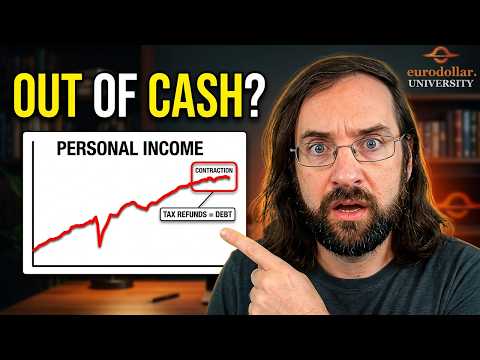
Average IRS refunds hit approximately $3,500 this tax season — up roughly $350, or 10%, from last spring. Americans are getting more money back. They're not spending it.
Early filers increased debt payments by about 20% in the three weeks after receiving refunds, according to David Tinsley, senior economist at the Bank of America Institute. Lower-income households went further — nearly 30% of their refunds went straight to debt repayment. Student loans, car balances, credit cards. The financial triage queue, not the checkout line.
This is not a surprise. It's a receipt.
The Macro Picture
The U.S. economy enters 2026 in a slow grind lower that started in mid-2024 — well before tariff uncertainty, well before the Iran conflict pushed gasoline to $4. The establishment survey showed zero net job growth for all of 2025. Not a slowdown. Zero. Revolving consumer credit — the kind that tracks with employment confidence, not interest rates — has been decelerating for months. The Federal Reserve's February data showed a near-flat seasonally adjusted revolving balance, following a weak January. December was a brief splurge; the trend before and after is unmistakable.
The labor market is the tide here. Tax refunds are a wave. When the tide is going out, waves don't push you back to shore.
Key Details
- Average refund: ~$3,500 — up ~10% year-over-year, per IRS data through early April, driven by tax changes under the "One Big Beautiful Bill" act.
- Debt repayment surge: +20% — early filers increased debt payments in the three weeks post-refund (Bank of America Institute).
- Lower-income households: ~30% to debt — the most financially stressed households are directing the largest share of refunds away from consumption.
- Revolving credit: near-flat — Fed consumer credit data for January and February shows credit card balances barely moving, consistent with a weakening labor market.
- Consumer sentiment: deteriorating across every major survey — not just the University of Michigan's headline number. The trend runs back to early 2024.
We've Seen This Movie
The 2008 Economic Stimulus Act sent roughly $100 billion in direct payments to approximately 130 million households — individuals received $300–$600, joint filers up to $1,200. A 2009 study found only one-fifth of recipients said they'd mostly increase spending. The most common plan: debt repayment. The marginal propensity to spend from the rebate was approximately one-third. The study's conclusion was blunt — the rebates provided "low bang for the buck as economic stimulus."
The 2001 Bush tax rebates produced nearly identical results. Savings spiked. Spending didn't follow. Economists later claimed the stimulus "kept it from getting worse" — a counterfactual nobody can disprove, which is precisely why it's the fallback.
The 2020–2021 payments appeared different, but the circumstances were structurally unique: an economy already bouncing off lockdown lows, supply chains in chaos, and a savings rate that hit 30% in April 2020 because there was nowhere to spend. The price impact was real, but it was driven more by supply destruction than by a Keynesian spending multiplier finally working as advertised.
"They're not just rushing out and blowing these refunds. They're also repairing their balance sheets." — David Tinsley, Senior Economist, Bank of America Institute
That quote is doing a lot of work. "Repairing balance sheets" is what you do when the damage is already done — when years of flat income growth, rising costs, and a softening job market have left households structurally weaker than the headline unemployment rate ever suggested.
The Keynesian Loop That Doesn't Close
The theory is simple: give people money, they spend it, businesses see revenue, they hire, workers have income, they spend more. The virtuous circle. The pump is primed.
The problem is the theory assumes people behave like they're in an economics textbook, not like people who've watched their real wages erode for two years while their credit card balances grew. Milton Friedman called it the permanent income hypothesis — people treat windfalls differently than regular income. You don't lock yourself into a car payment because you found $350 on the sidewalk. You pay down the card that's been charging you 24% APR.
When the labor market is softening, the propensity to save and deleverage doesn't just rise — it dominates. The refund becomes a buffer, not a spark. The circle never closes. The pump doesn't prime.
The Bottom Line
Watch revolving credit data and the next two months of JOLTS hiring numbers. If credit card balances continue to stagnate or contract while refunds are flowing in, the demand picture is worse than the GDP models are capturing. The refund bump is a one-time transfer, not a structural income improvement — and households know the difference even when economists pretend they don't.