Why it matters
A potential US blockade of the Strait of Hormuz — the narrow waterway connecting the Persian Gulf to the Gulf of Oman — would represent the single largest deliberate disruption to global oil supply in modern history. The market's muted response to $105 oil isn't confidence; it's dangerous complacency.
The big picture
The Strait of Hormuz handles roughly 20% of global oil trade and approximately 20-25% of global liquefied natural gas shipments. Every major Gulf producer — Saudi Arabia, the UAE, Kuwait, Iraq, and Iran itself — depends on it as their primary export artery. A blockade wouldn't just spike prices; it would restructure the global energy order overnight, with cascading effects on inflation, monetary policy, and equity valuations that markets are currently not pricing.
The Kobeissi Letter's core thesis is correct: the market is numb. But numbness is not the same as resilience. It's the same psychological pattern that preceded every major repricing event of the last decade — from the 2020 COVID crash to the 2022 rate shock. The absence of fear is itself the warning signal.
Key details
- WTI crude is trading at $105/barrel — a level that, if sustained, will mechanically push headline CPI back above 4% within two monthly readings, based on the energy component's historical weighting in the index
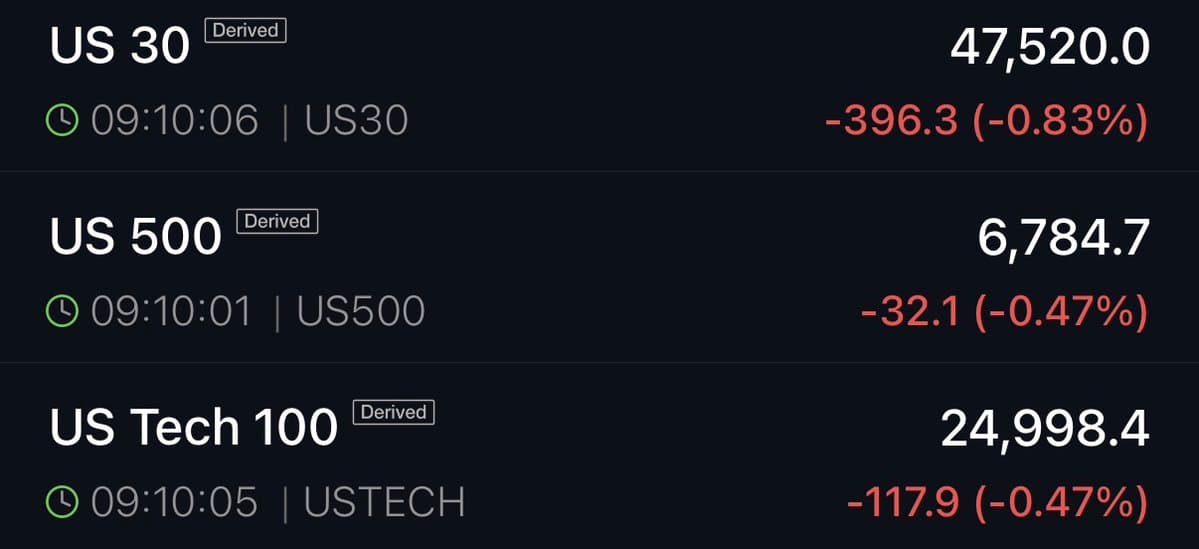
- SPY sits at $679.78, essentially flat (+0.05%) on the day — a non-reaction that defies the historical relationship between oil spikes and equity drawdowns; the 1973 oil embargo sent the S&P 500 down 48% over 21 months, the 1990 Gulf War spike preceded a 20% drawdown
- TLT is at $86.39 (-0.12%) — bonds are not rallying as a flight-to-safety trade, which means the market isn't even rotating defensively; it's simply standing still
- GLD is down 1.18% to $431.96 — gold declining during a geopolitical crisis of this magnitude is the most counterintuitive data point in today's tape; it suggests either forced selling elsewhere or a profound lack of conviction that this escalation is real
- The Strait of Hormuz is approximately 21 miles wide at its narrowest point — a chokepoint so constrained that even partial interdiction through mining or naval positioning could halt tanker traffic without a single shot being fired
- Iran has previously threatened to close the Strait during periods of US sanctions pressure — in 2012 and 2019 — but has never executed; a US-initiated blockade would be an entirely different operational and diplomatic scenario with no modern precedent
What they said
"The market is numb to the headlines. We just saw the worst possible outcome to US-Iran peace talks."
— The Kobeissi Letter, @KobeissiLetter, April 13, 2026
"Not only was a deal not reached, but the US itself is now set to blockade the Strait of Hormuz, military action is back in discussion, and US oil prices are up to $105/barrel."
— The Kobeissi Letter, @KobeissiLetter, April 13, 2026
Thesis: The Market Is Mispricing a Tail Risk
Kobeissi's framing is right, but it undersells the structural problem. This isn't just market complacency about a geopolitical headline. It's a systematic failure to model what a US-initiated Hormuz blockade actually means — not just for oil, but for the entire macro regime.
Start with the baseline: $105 WTI is already a problem. The Federal Reserve's current posture is predicated on inflation continuing its disinflationary trajectory. Oil at $105 — if it holds — breaks that assumption cleanly. The last time energy drove a CPI re-acceleration of this magnitude, the Fed was forced to abandon its pivot narrative entirely. A sustained $105 handle doesn't just complicate rate cuts; it potentially forces rate hikes back onto the table, and equity valuations built on a 2024-2025 soft landing thesis have no margin for that scenario.
Now layer in the blockade scenario itself. The US blockading Hormuz is not the same as Iran threatening to do so. When Iran threatens, markets price a low-probability event with high uncertainty. When the US executes, it becomes a certainty with a defined timeline. Tanker insurance rates would spike within 24 hours — Lloyd's of London war risk premiums during the 2019 Gulf of Oman incidents rose 10x in days. Shipping companies would reroute around the Cape of Good Hope, adding 15-20 days to transit times and immediately tightening physical supply. The spot market would detach from futures in ways that create cascading margin calls across commodity desks.
Evidence: Why the Non-Reaction Is the Story
The SPY's +0.05% move is not a vote of confidence. It's an absence of engagement. Look at the full tape: GLD down 1.18%, TLT down 0.12%, IWM up 0.20%. This is not a risk-off configuration. It's not even
This article was inspired by a post from @KobeissiLetter. AC's analysis adds original research, data context, and editorial perspective.