
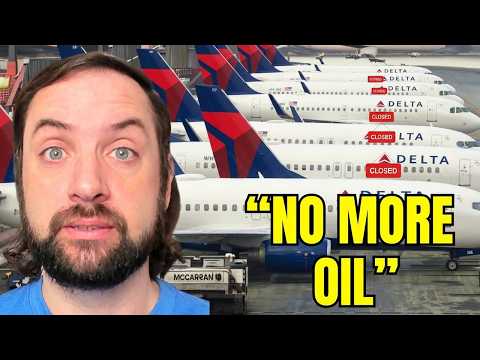
"Jet Fuel Is Running Out" The Airline Collapse No One Is Pricing In
Eurodollar University
★★☆ WATCH AT 2X
The deflationary shock framework and futures curve analysis are genuinely useful mental models, but the video repeats the same data points across 30+ minutes of runtime — the decode gives you the substance in a fraction of the time.
TL;DR
The Strait of Hormuz blockade has choked off roughly 17% of global oil supply, and the airline industry is the first visible casualty — flight cancellations, fuel rationing, and bag fee hikes are the early tremors. The speaker's core argument is that this is deflationary, not inflationary: costs spike but volume collapses faster, killing economic activity rather than sustaining higher prices. If the blockade persists even a few more weeks, the damage to the global economy is already baked in regardless of any deal.
Key Points
17% of global oil supply is blocked
Bloomberg's data puts the Hormuz disruption at 18.4 million barrels per day out of a 107 million barrel global supply — even with pipeline workarounds, the world is still running roughly 10% short every single day. That deficit compounds; inventories and in-process refinery feedstock are finite.
Jet fuel is the canary, not the crisis
Jet fuel is the first refined product to show shortage symptoms because it has a narrow supply chain and airlines are price-sensitive. Italy rationing, Korean carriers cancelling dozens of routes, and Vietnamese airlines cutting destinations are early-stage signals of what hits broader energy-intensive industries next.
Oil futures curve is telling two stories
Front-month WTI near $115 while back-month contracts (August onward) sit around $84 — a $30 spread. The front is panic buying from importers desperate for near-term supply; the back end is pricing demand destruction, not supply restoration. That divergence is the market's honest assessment of long-term economic damage.
Energy shocks are deflationary, not inflationary
This is the speaker's most important and most underappreciated point. Costs rise but volume disappears faster — fewer flights, fewer passengers, less economic activity. The bag fee hikes are noise; the flight cancellations are the signal. History backs this: the 1973 and 1979 shocks produced recessions, not sustained inflation.
Damage is already done even if deal closes tonight
Refineries need weeks to rebuild feedstock pipelines; airlines need time to restore cancelled routes; hoarding behavior creates secondary rigidities in fuel distribution. A diplomatic resolution stops the bleeding but doesn't reverse it — the economic hit from the past month is already in the system.
US airlines less exposed but not immune
The US produces significant domestic jet fuel, but aircraft refuel locally on international routes — United's Asia network is directly exposed. California and the West Coast face pipeline constraints that make them more vulnerable than the rest of the country. Bag fee hikes at Delta, United, and JetBlue are the first domestic pass-through.
Unemployment risk is the downstream threat
The speaker connects airline contraction to broader labor market deterioration — and the New York Fed consumer survey showing rising unemployment fears alongside muted inflation expectations supports this read. The credit market and Jamie Dimon's systemic risk comments are flagged as the next domino.
Claim Check
“Oil prices should be $130-150 but aren't because the market expects a quick resolution”
Misleading
5Y Breakeven Inflation at 2.57% (76th percentile); HY Credit Spreads at 3.16bp (34th percentile); SPY +2.31%, QQQ +2.96% on the day
The speaker's logic is internally consistent — futures markets discount probability-weighted outcomes, so low spot prices can coexist with severe physical shortages if resolution odds are high. But the broader market data doesn't show the panic you'd expect from a $130-150 oil environment: equities are up sharply, HY spreads are below median, and inflation breakevens are elevated but not extreme. Either the market is severely mispricing this or the physical shortage narrative is being overstated.
“No reason to expect inflation from this — costs go up but volumes disappear”
Mostly True
5Y Breakeven Inflation: 2.57% (76th percentile, +0.1bp 1M); 10Y Real Yield: 2.02% (81st percentile)
The deflationary-shock thesis has strong historical support and the speaker is right that volume destruction typically dominates in energy shocks. However, the 5Y breakeven at the 76th percentile suggests the market is pricing in some inflation persistence — not hyperinflation, but not nothing. Real yields at the 81st percentile also suggest the bond market is not in full demand-destruction mode yet. The claim is directionally right but presented with more certainty than the data warrants.
“Treasury auctions and credit markets reflect a deteriorating economic backdrop”
Mostly True
Three consecutive F-grade Treasury auctions (2Y, 5Y, 7Y in March 2026); B/C ratios all below 2.50
The speaker doesn't cite auctions directly, but the macro deterioration thesis is supported by three straight failing auction grades — weak demand for US Treasuries at these yields is a real stress signal. However, HY and IG credit spreads remain below their 5-year medians, which is inconsistent with imminent systemic stress. The bond market is sending mixed signals, not a clean confirmation of the speaker's thesis.
The Acid Take
The core thesis — Hormuz blockade as a deflationary demand-destruction shock, not an inflationary one — is correct and genuinely underappreciated by most retail investors who see higher prices and stop thinking. Where the speaker loses me is the gap between the physical shortage narrative and what markets are actually doing: equities ripping, credit spreads below median, no liquidity stress visible in the Fed balance sheet data. Either the market is catastrophically wrong or the supply disruption, while real, is being sized up at the extreme end of the range. Worth taking seriously, but dial back the apocalyptic framing by about 30%.
Decode another video
This decode was generated by AI using Marcus Reid's editorial framework. Claim checks reference publicly available market data. This is editorial analysis, not financial advice.