The Fed's Impossible Position
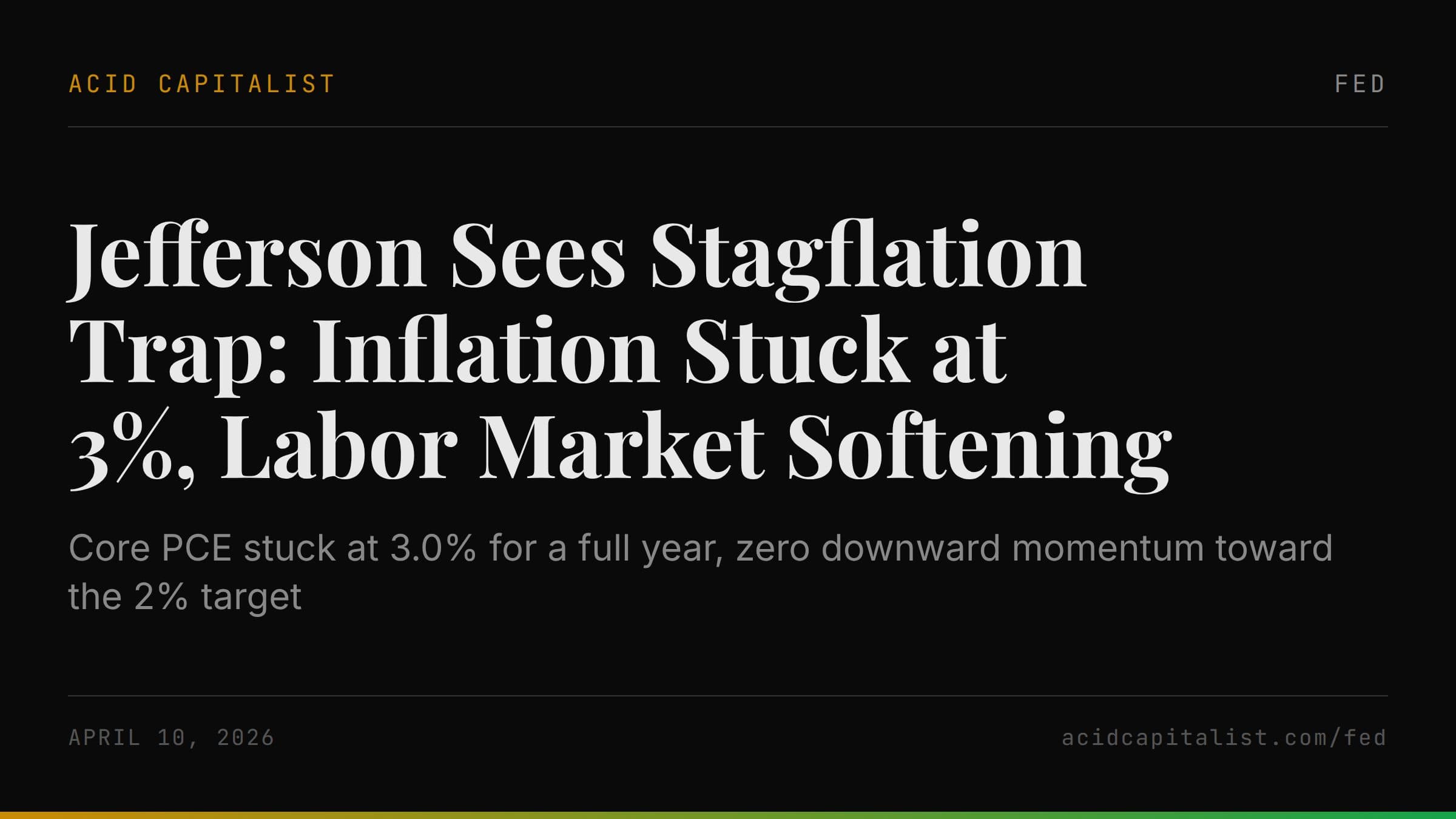
Fed Vice Chair Philip Jefferson just put the stagflation problem on the record. Speaking at the University of Detroit Mercy on April 7, Jefferson acknowledged what the data has been screaming for months: inflation is stuck well above target while the labor market is losing altitude. That's not a policy problem with a clean solution. That's a trap.
Why it matters: A Fed caught between sticky inflation and a softening labor market can't cut without risking a price spiral, and can't hold without risking a jobs collapse. That paralysis is a direct headwind for risk assets — and it keeps the rate cut timeline that markets have been pricing in looking increasingly like wishful thinking.
What the Data Actually Says
The consensus narrative on Wall Street is that the Fed is in a "patient hold" — rates at neutral, inflation gradually declining, labor market stable enough to wait. It's a comfortable story. It's also not what the numbers show.
Jefferson's own figures tell a harder story:
- Core PCE at 3.0% for the 12 months ending February — essentially flat for a full year. Not declining. Not trending toward 2%. Flat.
- Headline PCE at 2.8% — still nearly a full percentage point above target, with energy prices now adding fresh upward pressure.
- Q1 2026 average payrolls: ~70,000 per month — a number Jefferson himself called "somewhat subdued." For context, the labor market was adding 200,000+ per month as recently as 2024.
- Unemployment rate: 4.3% in March, down from a November 2025 peak of 4.5% — but still up 30 basis points from January 2025's 4.0%.
- The FOMC has cut 175 basis points since the easing cycle began, bringing the fed funds rate to what Jefferson describes as "broadly in the range of neutral."
Here's the problem with the neutral framing: neutral only works if inflation is heading toward target. At 3.0% core PCE with zero downward momentum, "neutral" is another word for "not tight enough."
The Consensus View — and Why It's Seductive
The bull case for rate cuts goes like this: tariff-driven inflation is transitory (we've heard that word before), the labor market is stabilizing at a "low-hire, low-fire" equilibrium, and once tariff pass-through fades, disinflation resumes. The Fed holds, data improves, cuts come in H2 2026. Markets price the soft landing. Everyone goes home happy.
Jefferson himself leans toward this framing. He describes the current stance as "well-positioned to respond to a range of outcomes" and expresses confidence that tariff effects will eventually fade.
"It has been my expectation that the disinflationary process would resume once higher tariffs are no longer pushing up consumer prices."
That's a reasonable hope. It is not a policy. And it assumes tariffs are a one-time shock rather than a structural repricing of the import cost base — an assumption that's getting harder to defend the longer trade policy uncertainty persists.
What the Signals Say Instead
The liquidity backdrop doesn't offer much comfort. Net liquidity is essentially flat — the Fed's balance sheet (WALCL) at $7 trillion, TGA at $1 trillion, RRP near zero. There's no fresh liquidity injection coming to bail out risk assets if the labor market deteriorates faster than Jefferson's baseline expects.
TLT is down 0.25% on the day, sitting at $86.70. The bond market isn't pricing imminent cuts — it's pricing a Fed that stays on hold longer than the equity market wants to believe. SPY at $679.91 and QQQ at $610.19 are grinding higher on momentum and AI infrastructure optimism, but that divergence between equity pricing and bond market reality is a tension that resolves eventually. It usually resolves in the bond market's favor.
Gold at $437.91 (+0.78%) is telling its own story: stagflation hedge demand is real and building.
Acid Take
Jefferson is describing a stagflation setup in the most diplomatic language possible, and the market is choosing not to hear it. Core PCE hasn't moved in a year. Job growth is running at 70,000 per month — barely breakeven, one bad shock away from negative. The Fed has already cut 175 basis points and inflation is still at 3.0%. The idea that holding at "neutral" will gradually solve both problems simultaneously is the kind of optimism that looks good in a speech and falls apart in the data.
The Fed's dual mandate is pulling in opposite directions at once. That's not a setup for a clean policy pivot. That's a setup for being wrong on at least one of them — and probably both.
Watch the next two core PCE prints. If they don't show meaningful progress toward 2%, the "patient hold" narrative collapses and the market has to reprice a Fed that's stuck — not patient.
Bias Flag: Jefferson's speech carries the institutional optimism baked into every Fed communication. Policymakers have structural incentives to project confidence in their framework — acknowledging that the framework itself might be inadequate is not something central
This article was inspired by Speech by Vice Chair Jefferson on the economic outlook and the labor market from Board of Governors of the Federal Reserve System. AC's analysis adds original research, data context, and editorial perspective.