Why it matters
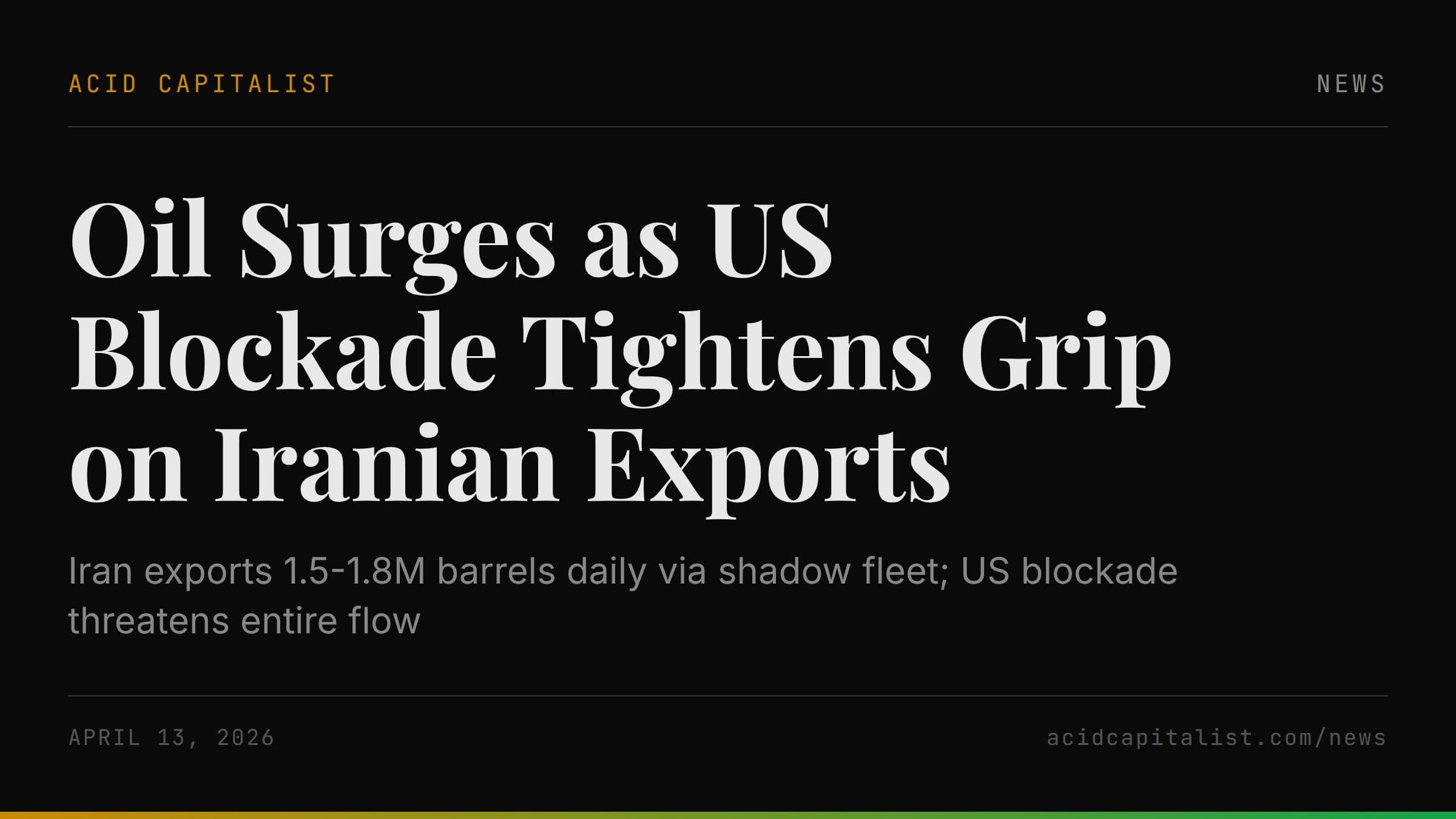
A US naval blockade tightening around Iranian crude exports removes a meaningful volume of oil from global supply at a moment when markets are already navigating tariff uncertainty and fragile demand signals. The price response is immediate — and the geopolitical risk premium is back on the table.
The big picture
Iran has been moving roughly 1.5–1.8 million barrels per day into global markets, primarily through shadow fleet tankers routed to Chinese refiners. A credible US interdiction effort doesn't just threaten that flow — it forces every buyer in that chain to reprice counterparty risk overnight. OPEC+ has spare capacity, but deploying it takes time, and time is exactly what a supply shock doesn't give you. Meanwhile, broader energy markets are already contending with a macro environment where TLT sits at $86.49 and equities are grinding sideways, signaling that the risk-free rate environment offers no cushion for energy-dependent economies absorbing a supply hit.
Key details
- Iranian crude exports have been running near multi-year highs despite existing sanctions, sustained largely by Chinese demand and a shadow tanker fleet operating outside Western financial systems.
- A US naval blockade — or credible threat thereof — functionally cuts off that route, as Chinese refiners cannot absorb the legal and financial exposure of receiving interdicted cargo.
- Brent crude surged on the news, with the move driven by pure supply-side math: fewer barrels available, same demand, higher clearing price.
- OPEC+ spare capacity exists on paper — Saudi Arabia and UAE hold meaningful buffer — but political will to deploy it quickly, and at the right price, is not guaranteed. The cartel has been managing production cuts, not preparing for emergency releases.
- Equity markets are not pricing a crisis yet — SPY is essentially flat at $679.46 (-0.07%), QQQ marginally positive at $611.07 (+0.14%), and IWM slightly lower at $261.30 (-0.25%) — suggesting the broader market views this as an oil-specific event, not a systemic shock. That read could change fast if Brent sustains above key technical levels.
What they said
Reuters' morning note framed the move in direct terms:
"Oil surged after the United States threatened to impose secondary sanctions and a naval blockade on Iran, ratcheting up pressure on Tehran's crude exports."
The framing from market participants tracked by Reuters pointed to the supply disruption as the primary driver:
"The market is focused on the potential loss of Iranian barrels — that's what's moving prices this morning."
The bottom line
The US is using energy as a weapon against Iran, and oil markets are responding with the only language they know — price. Until there is clarity on whether the blockade holds, whether China blinks, and whether OPEC+ steps in, the risk premium in crude stays elevated.