Why it matters
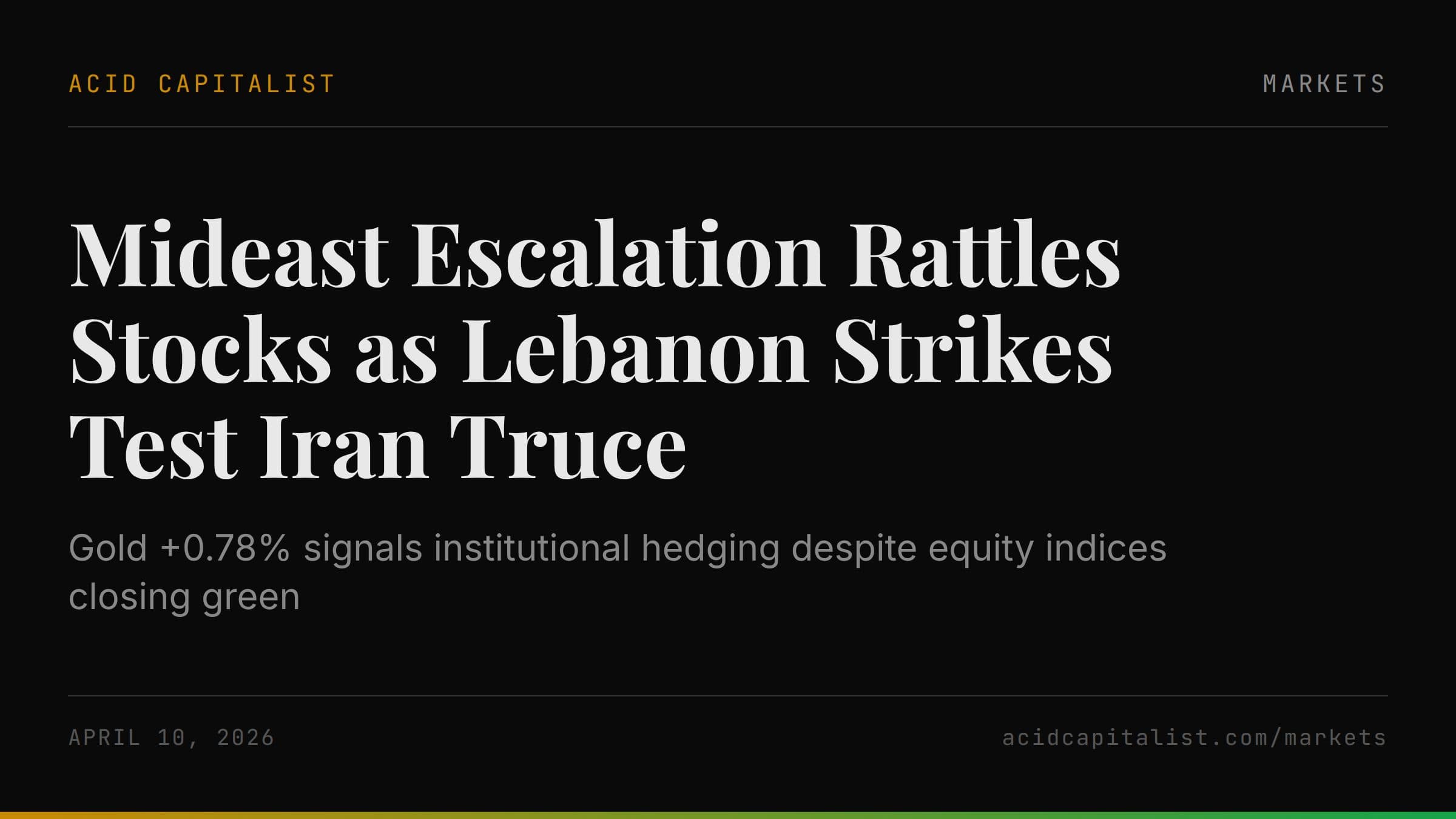
Israeli strikes on Lebanon are directly stress-testing the fragile Iran ceasefire framework, injecting fresh geopolitical risk into markets at a moment when traders were already navigating tariff uncertainty and a murky Fed outlook. A ceasefire collapse doesn't stay contained — it reprices oil, inflation expectations, and rate policy simultaneously.
The big picture
The Iran ceasefire was supposed to be a de-escalation anchor for Mideast risk. Israeli military operations in Lebanon now challenge that assumption, raising the probability of a wider regional conflict that pulls in Iranian-backed forces and, potentially, Iran itself. For markets, the core fear isn't the strikes in isolation — it's the chain reaction: oil supply disruption, energy inflation, and a Fed that loses room to cut even as growth softens.
Key details
- Equities held up on the day but the underlying bid was shaky — SPY closed at $679.91 (+0.58%), QQQ at $610.19 (+0.68%), and IWM at $261.96 (+0.57%), gains that look resilient on the surface but masked intraday volatility tied directly to headline flow out of the region
- Gold caught a safe-haven bid, with GLD rising 0.78% to $437.91 — a clear signal that institutional money is hedging geopolitical tail risk even as equity indices held green
- Bonds sold off, with TLT dropping 0.25% to $86.70 — a counterintuitive move that suggests inflation fears from a potential oil shock are outweighing the flight-to-safety impulse that typically lifts Treasuries during geopolitical stress
- The ceasefire architecture matters: the Iran deal was priced into risk assets as a structural reduction in Mideast volatility; any formal breakdown forces a wholesale repricing of the geopolitical risk premium embedded in equities, credit, and commodities
- Oil is the transmission mechanism — a wider conflict involving Iranian proxies or direct Iranian retaliation disrupts Gulf shipping lanes and production, feeding directly into energy prices and CPI prints that the Fed cannot ignore
Loading chart...
Loading chart...
What they said
Reuters reporting on the market reaction captured the core tension directly:
"Stocks were shaky as Israeli attacks on Lebanon tested the Iran ceasefire, with investors watching closely for signs the fragile truce could unravel."
The framing from traders in the piece underscored that positioning, not just sentiment, is shifting:
"Markets are trying to figure out whether this is a contained flare-up or the beginning of something that breaks the ceasefire framework entirely."
The bottom line
The equity gains Tuesday are real but don't tell the full story — gold up, bonds down, and intraday volatility driven by geopolitical headlines is not the profile of a market that's comfortable. If Israeli operations in Lebanon trigger Iranian retaliation or a formal ceasefire collapse, the risk-off move will be fast and the inflation implications will be durable, leaving the Fed with less flexibility precisely when the economy may need it most.
Bias flag
Reuters maintains generally balanced geopolitical reporting but applies a Western editorial framework to Mideast conflict coverage that can underweight Iranian and Hezbollah perspectives. Readers should cross-reference regional sources for a complete picture of the military and diplomatic situation on the ground.