The Math That Runs Institutional Money (And Why Your "High-Conviction" Setup Is Probably One Signal in a Costume)
Roan (@RohOnChain) dropped a thread this week that deserves more attention than the Bitcoin price action currently stealing everyone's oxygen. The core argument: hedge funds don't win by finding better signals — they win by combining more of them. And the mathematics behind that claim isn't opinion. It's a theorem.
Here's why this matters beyond quant Twitter.
Why It Matters
Every retail investor and independent trader operates with some version of a signal stack — whether they call it that or not. RSI divergence. COT positioning. Yield curve shape. Fed meeting outcomes. The question isn't whether you use signals. The question is whether you understand what they're actually worth individually, and what happens when you combine them wrong.
The answer, according to the Fundamental Law of Active Management, is that you're almost certainly overconfident in your edge and undersized in your diversification. That combination doesn't just reduce returns. It causes blowups on trades where you were directionally correct.
The Law That Runs Institutional Desks
The Fundamental Law of Active Management isn't new. Grinold and Kahn formalized it in the 1990s. But Roan's thread makes it accessible in a way that most quant writing doesn't bother to attempt.
The formula is deceptively simple:
IR = IC × √N
Break it down:
- IR = Information Ratio — the risk-adjusted return of your combined signal system. Think of it as your Sharpe Ratio, but specifically for active bets.
- IC = Information Coefficient — the correlation between what your signal predicts and what the market actually does. A perfect signal has an IC of 1.0. That signal doesn't exist.
- N = the number of genuinely independent signals you're running simultaneously.
The critical number that most traders don't sit with long enough: the best institutional signals — the ones running live capital at top systematic desks — have ICs between 0.05 and 0.15. That means even the sharpest quant signals are wrong the majority of the time. Not occasionally. Structurally, mathematically, most of the time.
Now run the math on what happens when you combine them.
- Single signal, IC = 0.10: IR = 0.10
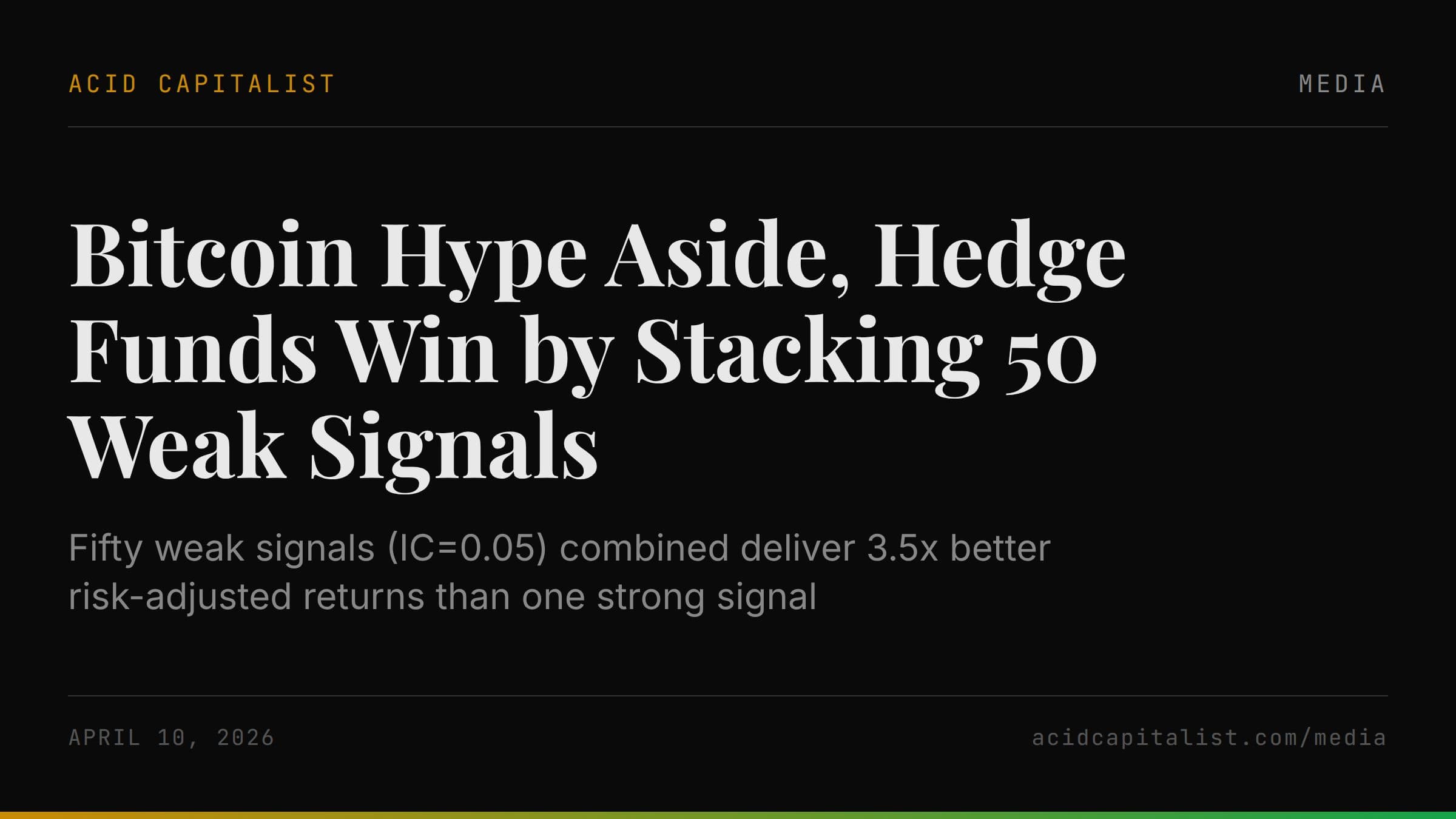
- 50 signals, each IC = 0.05 (half the individual strength): IR = 0.05 × √50 = 0.354
The 50-signal system at half the individual IC delivers more than 3.5x the risk-adjusted edge of the single stronger signal. That's not a marginal improvement. That's a structural transformation of what the system can do.
This is why Renaissance Technologies employs hundreds of researchers. Not because any one of them has found the holy grail signal. Because the math rewards breadth of independent signals over depth of any single one.
The Hidden Problem: Counting Signals You Don't Actually Have
Here's where Roan's thread gets genuinely important, and where most systematic traders — retail and institutional alike — get quietly destroyed.
The N in IR = IC × √N is not the count of signals in your stack. It's the effective number of independent signals after you've accounted for shared variance.
Think of it this way: imagine you're building a weather forecast and you consult five meteorologists. If four of them trained at the same school, use the same models, and read the same satellite data — you don't have five independent forecasts. You have one forecast expressed five times with slightly different wording. Your effective N is closer to 2.
The same thing happens with trading signals. Momentum and trend-following signals tend to move together. Value and mean-reversion signals often share underlying drivers. During macro stress events — a surprise CPI print, a Fed pivot, a credit event — signals that appear structurally independent can suddenly load on the same underlying factor simultaneously.
"The traders who consistently lose on trades they were analytically correct about are almost always losing to correlation they did not measure. They believed they had three independent reasons to be confident. They had one reason expressed three times at a size justified for three." — Roan (@RohOnChain)
This is the mechanism behind most systematic strategy blowups. Not bad signal selection. Not bad market timing. Leverage sized for 20 independent signals when you actually had 6. The direction was right. The sizing was calibrated for an independence structure that didn't exist.
Roan cites research covering 151 systematic trading strategies across major asset classes. The pattern is consistent: traders who measure effective independence and size accordingly dramatically outperform traders who count signals and assume independence.
The 11-Step Engine: What It's Actually Doing
The 11-step combination procedure Roan outlines is worth understanding at the conceptual level even if you never implement it in code. The logic reveals something important about how institutional desks think about edge.
The procedure does three things in sequence:
First, it normalizes. Every signal gets centered around zero and scaled to the same unit of measurement. A momentum signal measured in percentage returns and a microstructure signal measured in basis points become directly comparable.
This article was inspired by a post from @RohOnChain. AC's analysis adds original research, data context, and editorial perspective.