Why it matters
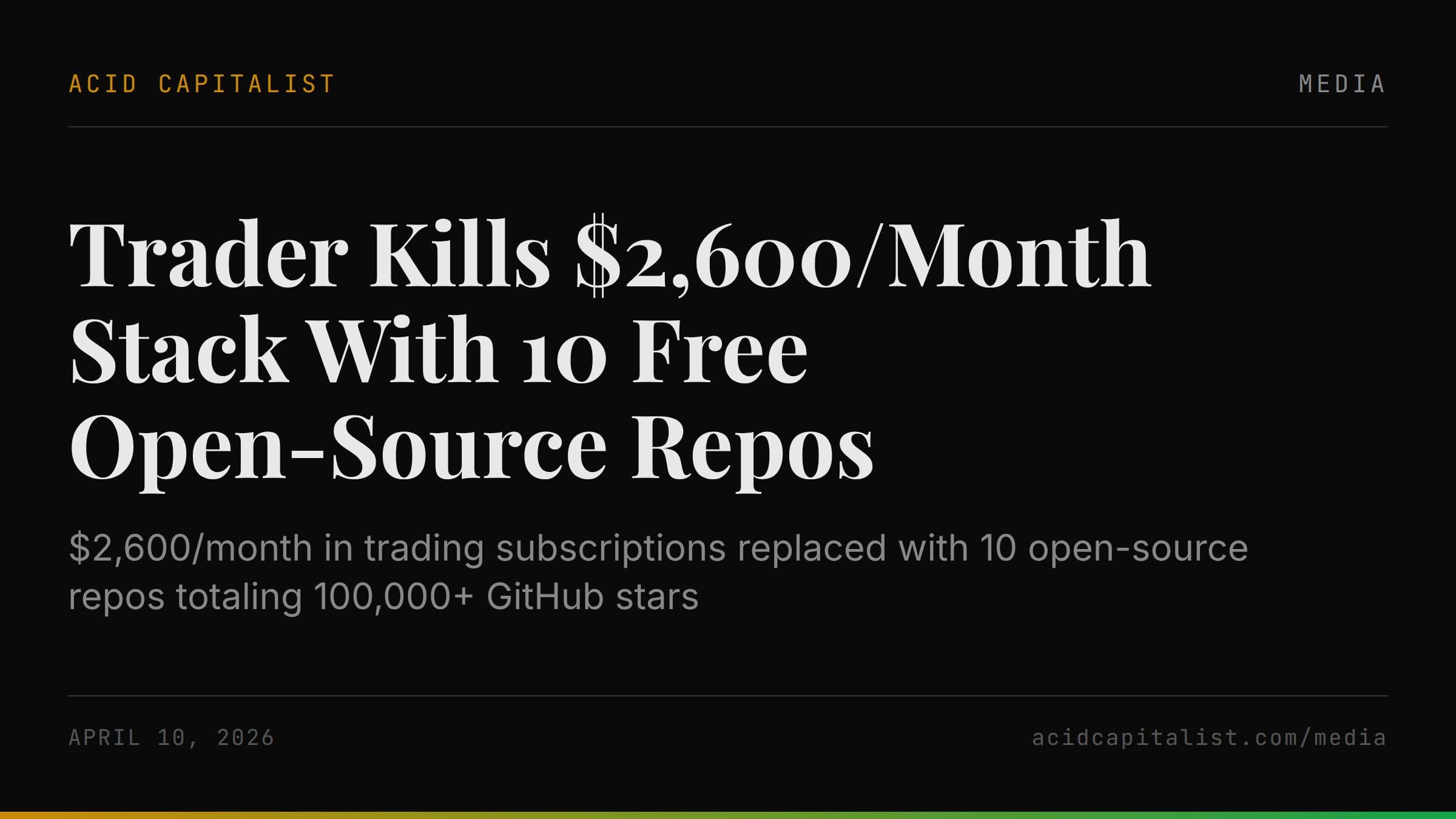
The gap between institutional-grade trading infrastructure and what retail traders actually pay for it has collapsed — and a single X thread just mapped the entire arbitrage in ten repos. When the tools professionals use get open-sourced by the companies that built them, the subscription model doesn't bend, it breaks.
The big picture
Open-source has been eating proprietary software for two decades, but financial tooling was supposed to be different — too specialized, too liability-adjacent, too dependent on data relationships to commoditize. That assumption is now empirically wrong. The repos in this stack weren't built by scrappy hobbyists reverse-engineering Bloomberg; several were built by the same companies charging retail prices for the closed versions. TradingView publishes lightweight-charts themselves. Block — Jack Dorsey's company, with a $40B+ market cap — maintains goose as a fully open agent framework. The institutional moat wasn't the software. It was the distribution.
The specific market this thread targets is also worth noting: prediction markets. Polymarket crossed $1B in monthly volume in 2024, and Kalshi received federal court validation of its event contracts. This isn't a niche. It's an emerging asset class with real liquidity, and the tooling ecosystem around it is maturing faster than most traders realize.
Key details
- Total subscription cost eliminated: ~$2,600/month ($31,200/year) — the single largest line item being a Bloomberg Terminal at $2,000/month, which runs $24,000/year at standard retail pricing
- Combined GitHub stars across the stack: 100,000+, with
goosealone carrying 35K stars andlightweight-chartsat 14K — star counts that indicate active maintenance and community vetting, not abandoned side projects - The Bloomberg replacement is structural, not cosmetic:
fredapipulls directly from the St. Louis Fed's FRED database — 800,000+ economic time series, the same underlying macro data Bloomberg packages and resells at a 10,000% markup - The bot framework (
Polymarket-Trading-Bot) ships seven distinct strategies: arbitrage, momentum, market making, AI forecast integration, whale copy-trading, and convergence — 53,000 lines of TypeScript representing months of engineering work, available at zero marginal cost - The one paid tool retained — Kreo — is explicitly justified by ROI, not sentiment: "the only tool on this list i actually pay for because it makes more than it costs" — a rational filter that distinguishes this thread from ideological open-source advocacy
What they said
"i cancelled $2,000/month in trading subscriptions — replaced every single one with open-source repos"
— self.dll (@seelffff)
"total before: ~$2,600/month — total now: $0 + Kreo"
— self.dll (@seelffff)
Going deeper: what the thread doesn't tell you
The thread is accurate as a list. It's incomplete as an analysis. Here's what it misses.
The real cost isn't the subscription — it's integration time. Canceling Bloomberg and spinning up fredapi with Claude as your query layer takes engineering hours. The thread presents this as a clean swap, and for a developer-trader it largely is. For someone whose Python stops at import pandas, the friction is real. The stack is free in dollars and expensive in time — which is itself a market signal. The traders who can execute this arbitrage are exactly the traders who were already underserved by subscription tools built for non-technical users.
The data layer deserves more scrutiny. fredapi covers macro — Fed data, CPI, yield curves, unemployment series. That's genuinely powerful for systematic macro strategies. What it doesn't cover: real-time equity order flow, options chain data, earnings call transcripts, alternative data sets (satellite imagery, credit card spend, shipping container counts). Bloomberg Terminal's actual moat for institutional equity traders isn't the macro data — it's the terminal's messaging network (IB chat), the speed of corporate action data, and the breadth of fixed income pricing. For prediction market traders specifically, FRED data is arguably more relevant than any of that, which is why the substitution works cleanly in this context. The thread is implicitly scoped to prediction markets and macro, and that scope matters.
The AI layer is the real unlock, and it's underplayed. The thread mentions Claude twice — once as the query interface for FRED data, once as the agent that gets $10,000 in paper money to trade via polymarket-paper-trader. This is the architectural shift that makes the whole stack coherent. Five years ago, replacing Bloomberg required hiring a quant to write custom data pipelines. Today, a capable LLM can translate natural language macro queries into FRED API calls, summarize the output, and flag anomalies — collapsing what was a $2,000/month service into a $20/month API cost. The rtk repo — a Rust CLI proxy that cuts Claude Code token usage by 60-90% — is the efficiency layer that makes the AI component economically sustainable at scale.
The goose inclusion signals something larger. Block open-sourcing a full agent framework with 35K stars isn't a charitable act — it's a
This article was inspired by a post from @seelffff. AC's analysis adds original research, data context, and editorial perspective.