The Wall Just Got Shorter
Regime detection has always been the moat separating institutional quant desks from everyone else. Not because the math is secret — Hidden Markov Models have been in academic literature for decades — but because implementing them requires a data pipeline, a Python environment, statistical modeling chops, and enough time to debug all three simultaneously. Most retail traders hit that wall and go back to RSI crossovers.
Claude Code just made that wall significantly shorter.
Why This Actually Matters
The specific capability being democratized here isn't just "AI writes code for me." It's probabilistic regime classification — the ability to ask not where is price going but what kind of market is this right now. That's a structurally different question, and it's the one Renaissance Technologies built its edge on. When your model knows it's in a trending regime versus a choppy one, every downstream strategy decision changes: position sizing, entry confirmation requirements, leverage, hold duration. Regime detection is the prior that makes everything else more accurate.
For crypto specifically, this matters more than in equities. Bitcoin cycles through regimes faster and more violently than most asset classes. A momentum strategy that prints in a bull run gets destroyed in chop. A mean-reversion strategy that works in sideways consolidation bleeds out in a trending move. Without regime classification, you're running the wrong playbook half the time and not knowing it.
The Big Picture
We're in a phase of the current cycle where on-chain data shows Bitcoin entity-adjusted hodl waves still weighted toward long-term holders, with exchange balances near multi-year lows — a structural supply squeeze that's been building since late 2024. Stablecoin supply has been recovering after the Q3 2024 contraction, which means DeFi liquidity isn't in crisis mode, but it's not flush either. The macro backdrop — Fed holding rates while inflation data stays sticky — means crypto is trading on its own internal dynamics more than rate-cut anticipation right now. In that environment, regime detection tools that can distinguish genuine trend from noise have real signal value.
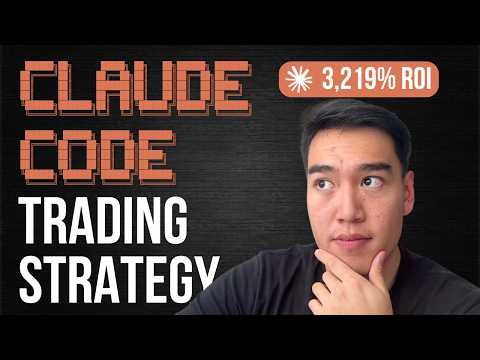
The video demonstrates a system built in Claude Code that classifies Bitcoin into seven market states using Gaussian HMMs trained on returns, price range, and volume change across 11,000 hourly samples. The output: a live regime label, a confidence probability, and a signal (long, hold, or cash) that only fires when the regime is bullish and seven of eight technical confirmations pass.
Key Details
-
Seven-regime HMM trained on 730 days of hourly Bitcoin data — approximately 17,000 data points processed before the model places a single simulated trade. This isn't a simple moving average crossover; it's a probabilistic map of market states built from scratch on each run.
-
Back-tested 2-year total return: ~3x initial capital — with a 65% total return, 63% alpha versus buy-and-hold, and a 41% maximum drawdown. The drawdown number is the one to watch: 41% is aggressive, and the video acknowledges this is a starting point for iteration, not a finished product.
-
Entry requires 7 of 8 confirmations — RSI, momentum, volatility, volume, ADX, price structure, and MACD all need to align inside a bullish regime before a position opens. This two-factor authentication structure (regime + strategy confirmations) is what separates this from a standard indicator stack.
-
Exit is regime-driven, not price-driven — positions close immediately when the regime flips from bullish to bearish or crash. No trailing stop second-guessing, no price target optimization. The regime is the exit signal.
-
48-hour hard cooldown after any exit — signal hysteresis baked into the architecture. This is the "minimum hold" mechanic that prevents the model from whipsawing in and out during regime transitions, which is where most systematic strategies bleed.
What They Said
"The money isn't just made on knowing when to enter. Sometimes it's best just to wait and determine what to do — and in the patience to not just re-enter another regime. I think that's where a lot of this magic and profitability is truly shown inside the regime terminal."
This is the most honest line in the video. Regime confirmation lag — waiting for a state to stabilize before acting — is where systematic strategies actually outperform discretionary ones. Most retail traders can't sit on their hands. A model with a hard cooldown can.
"Even though the HMMs stay stable, the strategies always adapt. A 2020 bull run regime would have required a breakout strategy, whereas in 2024, the bull run regime would have required something like a mean reversion strategy instead since the market is much more efficient."
This is the architectural insight worth keeping. The regime detection layer is the stable core; the strategy layer on top is what gets retrained as market microstructure evolves. Separating those two concerns is what makes this more durable than a static TradingView script.
The Bottom Line
The on-chain signal to watch is regime stability: how long Bitcoin stays in a classified bull-run state without flipping, and whether stablecoin supply continues recovering to support DeFi leverage. If stablecoin supply contracts again while the HMM is showing bull-run confidence, that's the diverg