Why it matters
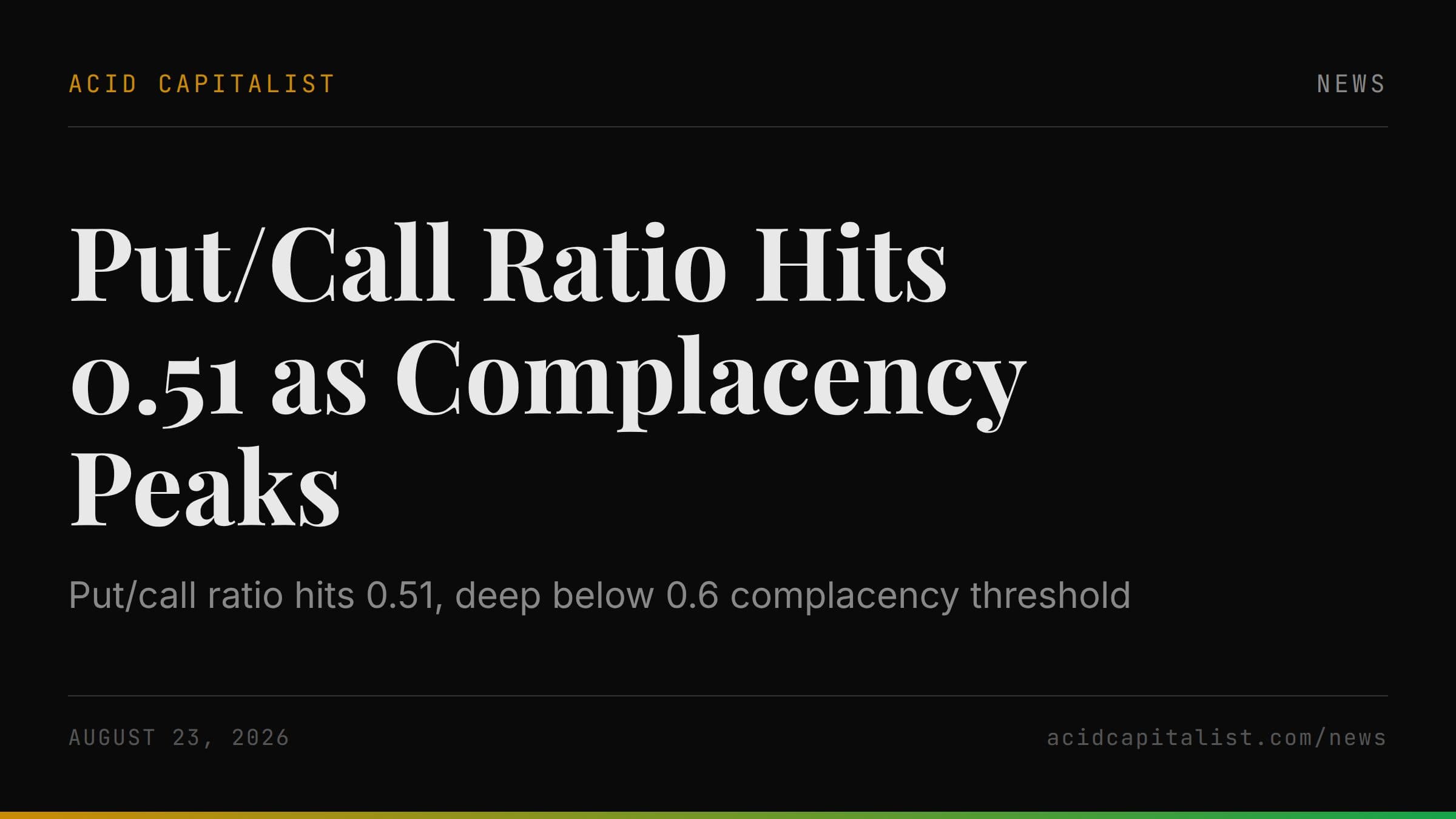
A put/call ratio of 0.51 means options traders bought roughly two calls for every one put on August 21, 2026—a positioning extreme that historically precedes volatility, not calms it. When bearish hedges disappear this completely, markets lose their shock absorbers.
The big picture
SPY sits at $765.72, up 0.41% on the session, while QQQ ($713.44, +0.35%) and IWM ($299.96, +0.77%) grind higher in tandem. Small caps outperforming large caps and a broad-based rally in low-volatility conditions is exactly the environment where put/call ratios compress—but it's also the environment where nobody is paying for insurance right before they need it. Gold's 1.95% pop in GLD to $423.36 is the one dissonant note in an otherwise risk-on tape, suggesting some capital is quietly hedging elsewhere even as options desks go all-in on calls.
Key details
- The put/call ratio at 0.51 sits well below the 0.6 complacency threshold and nowhere near the 1.0 bearish flip point—this is a one-sided market by any historical measure.
- For every 100 call contracts traded, only 51 puts changed hands, the kind of skew typically seen at or near local tops, not mid-cycle.
- TLT's -0.35% move to $82.05 shows bonds aren't confirming the equity complacency story—rates aren't falling in sympathy with the "everything's fine" options positioning.
- Net liquidity data shows $6B against a WALCL of $7B and TGA of $1B, with 30-day change effectively unreported (N/A)—meaning the liquidity backdrop driving this complacency isn't cleanly visible in the data itself.
- Small caps (IWM +0.77%) leading large caps (SPY +0.41%, QQQ +0.35%) is often read as healthy breadth, but it's also consistent with late-stage rallies where capital rotates into higher-beta names as the easy gains in mega-caps dry up.
What they said
"That 0.51 put/call ratio sits deep in complacency territory—well below the 0.6 threshold—while SPY grinds to $765.72 on barely-there volatility."
The data itself does the talking here: Cboe's daily options statistics confirm the 0.51 print as of August 21, 2026, with the bearish threshold set at >1 and complacency defined at <0.6—putting this reading firmly in the danger zone by the exchange's own framework.
The bottom line
A 0.51 put/call ratio isn't a prediction—it's a mirror. It shows a market that has stopped pricing in downside risk while prices grind higher on low volatility, and that combination has a well-documented tendency to reverse sharply when the complacency finally breaks. Watch for divergences—like GLD's strength against a backdrop of unhedged equity longs—as the tell that not everyone believes the rally.
Bias flag
This analysis leans contrarian by design—treating extreme sentiment readings as inherently unstable rather than confirming trend strength. That's a defensible framework backed by historical put/call extremes, but it's worth noting the piece doesn't weigh the case that low put/call ratios can also simply reflect genuine, sustained bullish conviction rather than imminent reversal.