The Insider Signal the Iran War Couldn't Break
Corporate insiders are buying. Not nibbling — actually buying, at the highest rate in five months, right through the noise of a Middle East war that has retail investors refreshing their brokerage apps in a cold sweat.
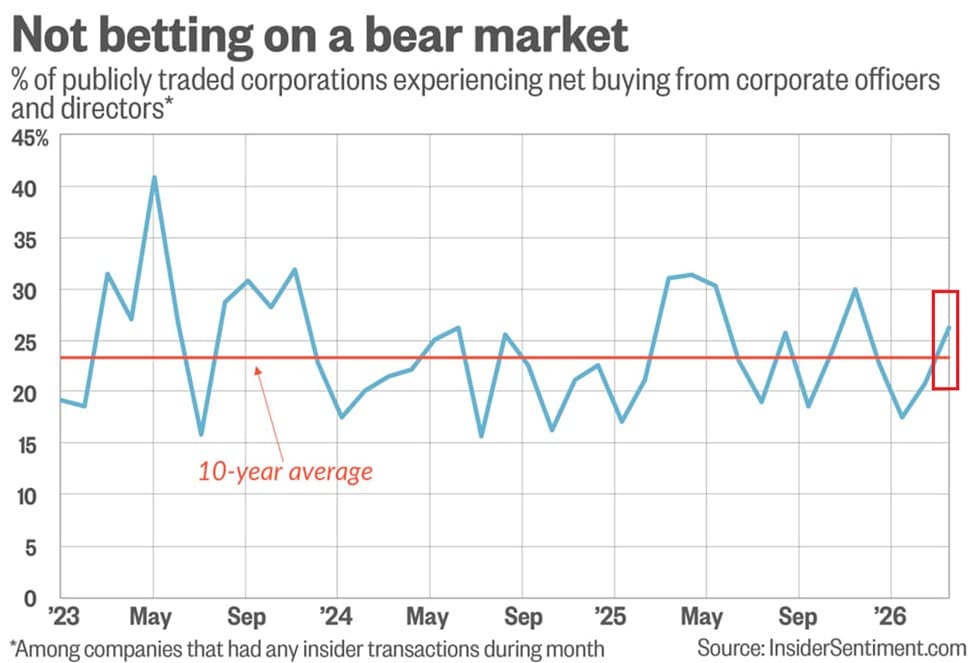
The Kobeissi Letter flagged the headline number on April 10: 26.4% of US publicly traded companies saw net insider purchases in March. That's up from 20.9% in February, the second consecutive monthly increase, and above the 10-year average. It's a clean data point. But the thread stops before the interesting part starts.
Let's go deeper.
What Insider Buying Actually Measures
First, a translation for anyone who's seen this metric thrown around without context.
The insider purchase ratio tracks the percentage of publicly traded companies where insiders — executives, directors, and 10%+ shareholders — are net buyers of their own stock in a given month. These are people with legal obligations to disclose their trades within two business days. They can't trade on material non-public information, but they can — and do — buy when they think the market is mispricing their company.
Think of it as a distributed poll of the people closest to the actual business. Not analysts with price targets to justify. Not fund managers with quarterly redemption pressure. The people who see the order books, the pipeline, the hiring plans, and the balance sheet in real time.
When that number hits 26.4%, it means more than one in four publicly traded US companies has insiders putting their own money on the line. That's not a sentiment survey. That's skin in the game.
The Iran War Context Is the Whole Story
Here's what makes March's reading genuinely interesting: it didn't happen in a vacuum of calm markets. It happened during a geopolitical shock that sent oil spiking, pushed safe-haven flows into gold (GLD is up 0.78% today, sitting at $437.91), and gave every financial media outlet a reason to run "markets in turmoil" headlines.
Retail investors did what retail investors do under geopolitical stress — they sold. Or they froze. The AAII sentiment surveys during conflict periods reliably show a spike in bearish readings. The VIX moves. The headlines scream.
Insiders bought anyway.
This is the oldest information asymmetry in markets. Geopolitical risk is visible, loud, and emotionally compelling. Business fundamentals are slow-moving, quiet, and boring. Retail investors price the visible risk. Insiders price the boring fundamentals. The gap between those two pricing mechanisms is where the signal lives.
The pattern isn't new. During the early weeks of the Russia-Ukraine war in February 2022, insider buying ticked up even as the S&P sold off sharply. During the COVID crash in March 2020 — one of the most violent drawdowns in modern history — insider buying hit multi-year highs within weeks of the bottom. The insiders weren't calling the exact bottom. They were signaling that the business reality didn't match the market panic.
March 2026 looks like the same setup.
What the Broader Data Says
The insider signal doesn't exist in isolation. Run it against the current macro backdrop and the picture gets more interesting.
Equity markets are holding. SPY is at $679.91, up 0.58% today. QQQ at $610.19, up 0.68%. IWM — the small-cap read, which tends to be more sensitive to domestic economic conditions — is up 0.57% at $261.96. These aren't the price levels of a market that's genuinely pricing a sustained geopolitical crisis into fundamentals. The surface is choppy; the structure is intact.
Gold is elevated but not panicking. GLD at $437.91 with a 0.78% daily gain tells you safe-haven demand is real. But gold at these levels isn't pricing Armageddon — it's pricing uncertainty. There's a difference. Uncertainty is tradeable. Armageddon is not.
Bonds are soft. TLT at $86.70, down 0.25% today. Long-duration Treasuries aren't catching the flight-to-safety bid you'd expect if institutional money was genuinely repositioning for a prolonged conflict. When the smart money is truly scared, Treasuries rally hard. They're not rallying. That tells you something.
Net liquidity is flat. The latest read shows net liquidity at approximately $6B — essentially unchanged over the past 30 days. The Fed balance sheet (WALCL) at $7B, TGA at $1B, RRP at $0B. The liquidity pool isn't draining. It's not filling either, but flat liquidity with intact equity markets and rising insider buying is not a bearish configuration. The tide isn't going out.
The Two-Month Trend Is the Real Signal
One month of elevated insider buying can be noise. Two consecutive months of increases — from 20.9% in January to the current 26.4% — starts to look like a trend. And trends in insider buying data have historically preceded equity market recoveries by 4-8 weeks.
The mechanism is straightforward: insiders see something that hasn't shown up in the public
This article was inspired by a post from @KobeissiLetter. AC's analysis adds original research, data context, and editorial perspective.